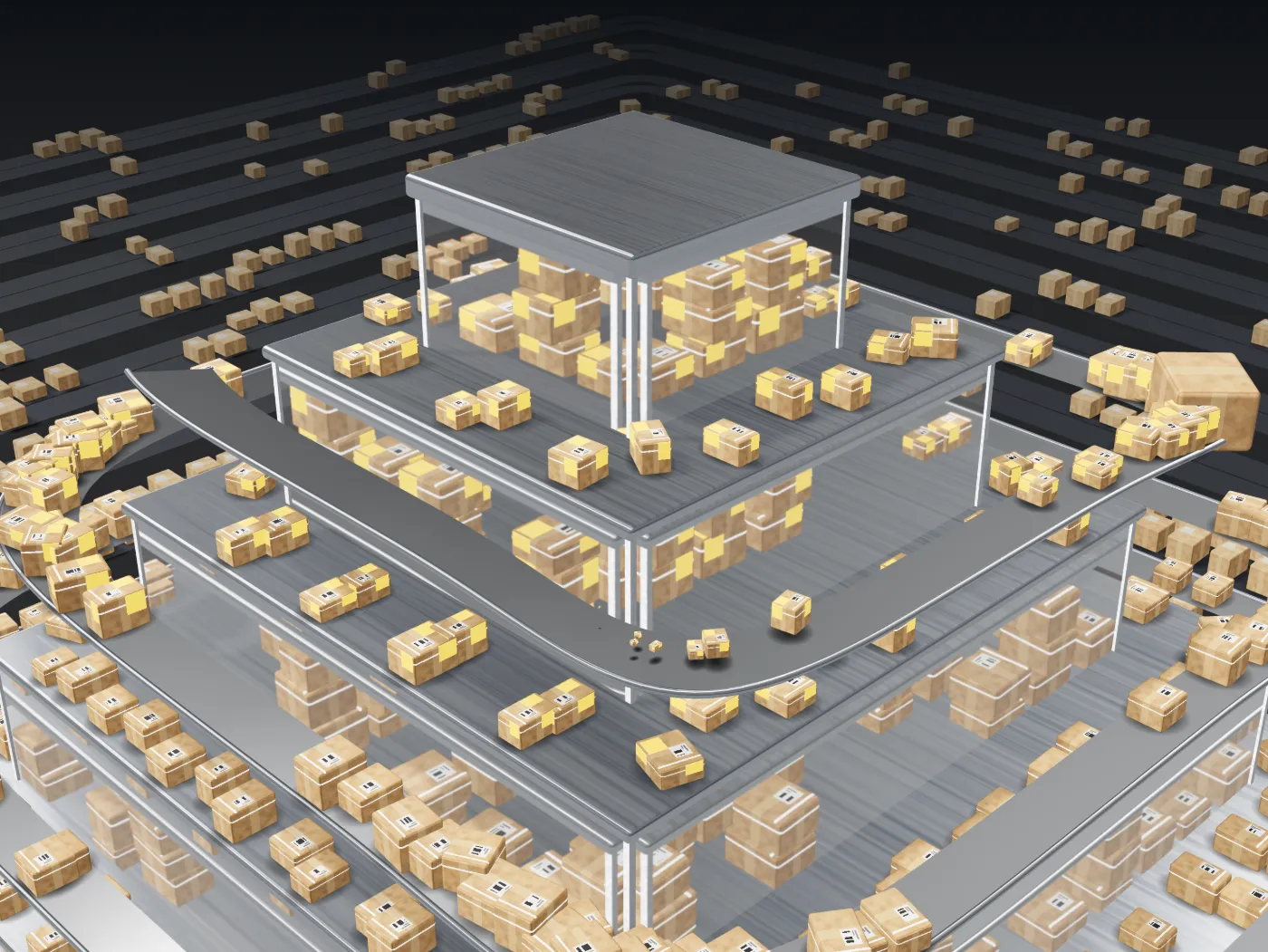
A freight forwarder for Amazon FBA: what it must do, and what Amazon will refuse
The freight forwarder Amazon FBA sellers hire moves your inventory from an overseas factory to Amazon's fulfillment centers, through customs and to Amazon's receiving rules. This guide covers what the forwarder handles, the Amazon box, label and appointment rules it must follow, customs and the importer of record, shipping modes, and how Amazon Global Logistics compares.
Key takeaways
- A freight forwarder books and coordinates the move from factory to Amazon: pickup, export, ocean or air freight, customs clearance and delivery.
- Amazon refuses shipments that break its rules: every box needs an FBA Box ID label, most boxes must stay under 25 x 25 x 36 inches and 50 lb, and every delivery needs a dock appointment.
- Amazon will not act as your importer of record; you or someone you appoint must, with a customs bond, correct HTS codes and customs values.
- Amazon Global Logistics is Amazon's own door-to-door freight program from China, Hong Kong and Vietnam, with placement options that can remove the inbound placement fee.
- Since January 1, 2026 Amazon no longer preps or labels in the US, so units must be prepped and labeled before they leave the factory or forwarder.
What a freight forwarder does for Amazon FBA sellers
A freight forwarder arranges international shipping on your behalf. For an Amazon FBA seller importing from a factory abroad, that usually means collecting the goods at origin, handling export paperwork, booking ocean or air freight, arranging customs clearance at the destination, and delivering the cartons to an Amazon fulfillment center or a warehouse in between.
What makes a forwarder right for Amazon FBA is not the freight itself but the last step. Amazon has strict rules for what arrives at its docks: labels, box sizes and weights, pallets and appointments. A forwarder that ships well but does not know those rules can get a whole container refused at the fulfillment center, at your expense.
Amazon also runs its own door-to-door freight program, Amazon Global Logistics, which covers pickup at origin, export, freight, customs clearance and delivery into Amazon's network from China, Hong Kong and Vietnam. Many sellers compare it with independent forwarders before each shipment.
- Forwarder
- Arranges the journeyFreight, documents, customs, delivery
- Customs broker
- Clears the goodsFiles the customs entry for the importer
- Importer of record
- You or your appointeeResponsible for compliance and duties
- Amazon
- Receives at the dockRefuses shipments that break its rules
The route from factory to fulfillment center
| Stage | Who usually does it | What can go wrong |
|---|---|---|
| Prep and labeling | The factory, a prep provider or the forwarder at origin | Units without labels; Amazon no longer labels in the US |
| Pickup and export | The forwarder | Missing commercial invoice or packing list |
| Ocean or air freight | The forwarder's carrier | Delays, rolled bookings |
| Customs clearance | A licensed customs broker | Wrong HTS code or value, held shipments |
| Delivery to Amazon | The forwarder or a trucking partner | No dock appointment, wrong labels, refused at the dock |
The FBA shipping process with a forwarder, step by step
The shipping process starts in Seller Central, not at the port. You create the shipment in the Send to Amazon workflow, which assigns the fulfillment center destinations and generates the FBA Box ID labels. Those labels and destinations go to the factory or forwarder, which is why the forwarder needs either the label files or limited access to your account.
From there the forwarder runs the cross border part: pickup, export, freight and customs, then a delivery appointment at the fulfillment center. Your part is to keep the shipment in Seller Central matching what is physically in the boxes, since Amazon's rules say the shipment details in your plan must match what arrives.
| Step | Who | Output |
|---|---|---|
| Create the shipment in Send to Amazon | You | Destinations, box labels, shipment ID |
| Prep and label units, pack and label boxes | Factory, prep provider or forwarder | Cartons ready for Amazon |
| Book freight and pickup | Forwarder | Booking, cargo receipt |
| Export, freight, customs clearance | Forwarder and customs broker | Entry filed, goods released |
| Book the dock appointment and deliver | Forwarder's carrier | Delivered to the fulfillment center |
| Check in and reconcile | Amazon, then you | Units received; discrepancies claimed |
Amazon's receiving rules your forwarder must follow
Amazon's shipping and routing requirements page tells sellers to share its rules with their carrier, because failing them can mean refusal at the fulfillment center, blocked future shipments, and inbound defect fees. These are the rules that decide whether a forwarder's delivery is received.
What every shipment needs
- A unique FBA Box ID label on every box, from your Shipping Queue
- Four FBA Pallet ID labels per pallet, one on each side, plus box labels
- Rigid six-sided boxes, most no larger than 25 x 25 x 36 inches
- Boxes of 50 lb or less, unless one item is heavier; Team Lift labels over 50 lb
- An advance dock appointment made by the carrier
- Accurate box weights and dimensions in the shipment
What gets shipments refused or blocked
- No dock appointment
- Oversize or overweight boxes of standard items
- Pallet-sized boxes, known as gaylords
- Old labels and barcodes left on reused boxes
- Items from several shipment IDs mixed in one box
- Deliveries to the wrong fulfillment center
Amazon adds that when a distributor or forwarder ships directly to a fulfillment center, it must have the correct FBA Box ID labels, and you can grant it limited access to your seller account to print them. Refused shipments are returned at your expense, and shipments delivered in unsellable condition incur a return freight charge.
Customs, the importer of record and duties
Amazon's customs page for Amazon Global Logistics is clear on one point that applies to any forwarder: Amazon will not act as importer of record, consignee or partner government agency agent for any shipment. You, or an entity you appoint, must be the importer of record for inventory entering the US. Amazon is the ultimate consignee for FBA shipments to US fulfillment centers.
The importer of record ensures the goods comply with US law, files the customs entry through a broker, and pays duties and taxes. A US customs bond guarantees those payments; a continuous bond, which Amazon Global Logistics requires, must equal 10% of the estimated duties, taxes and fees.
| Item | What it is | Who provides it |
|---|---|---|
| Commercial invoice | The sale and value of the goods | You or the shipper |
| Packing list | Contents of each carton | You or the shipper |
| Bill of lading or airway bill | The carrier's receipt and contract | The carrier |
| Entry summary | The customs entry | The customs broker |
| HTS code | Tariff classification of each product | The importer of record decides; the broker can review |
| Customs value | Usually the transaction value | You; nominal or false values are scrutinized |
Two US fees apply to every import, per Amazon's page: a merchandise processing fee of 0.3464% of the customs value, up to $485 per shipment, and, for ocean freight, a harbor maintenance fee of 0.125% of the customs value. Duties depend on the HTS code, value and country of origin, and wrong codes can mean held shipments or penalties.
Supplier shipping terms: who pays for which leg
Before you choose a forwarder, agree the shipping terms with your supplier, because they decide where the supplier's responsibility ends and the forwarder's begins. International trade uses standard terms, known as Incoterms, published by the International Chamber of Commerce. Three come up most often when sellers import goods for FBA.
Whatever the terms, one Amazon requirement does not move: someone must be the importer of record, and it is never Amazon. With delivered duty paid offers, ask who that is and get it in writing, since it is the party answerable to US Customs for the goods you will be selling.
| Term | The supplier's side | Your or your forwarder's side |
|---|---|---|
| EXW, ex works | Makes the goods available at its factory | Everything from pickup: export, freight, customs, delivery |
| FOB, free on board | Delivers the goods loaded on the vessel at the origin port | Ocean freight, insurance, import customs and delivery to Amazon |
| DDP, delivered duty paid | Delivers to the destination with import duties paid | Receiving; check who acts as importer of record |
FOB is a common middle ground: the supplier handles origin transportation and export, and your forwarder takes over at the port with the experience to meet Amazon's receiving requirements. Whichever terms you choose, make sure the information on the commercial invoice matches the goods, their value and the terms, since customs relies on it.
FCL, LCL or air: choosing a shipping mode
| Mode | What it is | Fits when |
|---|---|---|
| Full container load (FCL) | Your cargo alone in a 20 or 40 foot container | You have enough volume to fill most of a container |
| Less than container load (LCL) | Your cartons share a container with others' | Smaller shipments, without waiting to fill a container |
| Fast ocean | Expedited ocean freight | Faster replenishment without air prices |
| Air freight | The fastest mode; Amazon Global Logistics quotes 7 to 10 days into its network | Urgent restocks and high value, light products |
With FCL and LCL, cargo can be floor loaded, placed directly in the container without pallets to use more space, or palletized. Floor loaded cargo usually needs palletizing or unloading before it reaches Amazon's dock, so ask the forwarder who does it and what it costs.
Amazon Global Logistics compared with an independent forwarder
Amazon Global Logistics is Amazon's door-to-door ocean and air freight program, part of Amazon Supply Chain Services. Its pricing covers pickup at origin, export declaration, freight, destination customs clearance and delivery to Amazon, and you book, pay and track in Seller Central. Amazon offers new FBA sellers an 8% discount on base ocean rates for 60 days after onboarding.
| Amazon Global Logistics | Independent freight forwarder | |
|---|---|---|
| Routes | Mainland China, Hong Kong and Vietnam to the US, UK, France, Germany, Italy, Spain and Japan | Any origin and destination the forwarder serves |
| Eligibility | Requires FBA enrollment and a minimum Sponsored Products monthly budget | Anyone |
| Customs | Assigned customs brokers; you remain importer of record | The forwarder's broker or your own |
| Booking | In Seller Central, with Send to Amazon | By quote, outside Seller Central |
| Placement options | Amazon Managed Placement, minimal splits, Seller Managed Placement, Ship to AWD | Whatever you choose in Send to Amazon |
| Other destinations | Amazon's network only | Your own warehouse, a 3PL, other channels |
An independent forwarder is the choice when you ship from other countries, want stock delivered to your own warehouse or a 3PL first, or sell on channels beyond Amazon. Amazon Global Logistics is the simpler choice when everything goes from China, Hong Kong or Vietnam straight into FBA or AWD.
Inbound placement: the fee your freight plan can avoid
Amazon charges an FBA inbound placement service fee for distributing your inventory across fulfillment centers near customers, and the amount depends on the placement option you choose. Amazon Global Logistics offers options that remove it, and Amazon's own examples show how much the choice matters.
| Option | How it works | Inbound placement fee | Condition |
|---|---|---|---|
| Amazon Managed Placement | Ship to one location; Amazon divides it across centers | None; included in the rate | No more than 2,000 cartons per 40 foot, 1,000 per 20 foot container |
| Minimal shipment splits | Ship to a single fulfillment center | Charged | One sort type per container |
| Seller Managed Placement | Split across regional cross-docks yourself | None | Standard size; at least five identical boxes per ASIN mix |
| Ship to AWD | Bulk storage that replenishes FBA | Covered by AWD pricing | Standard size, non-perishable; no hazmat, jewelry, shoes, watches |
Amazon's help page works through a 40 foot container of 25,000 high density units: $6,340 with Seller Managed Placement, $8,330 with Amazon Managed Placement, and $11,541 with minimal shipment splits once the $7,500 placement fee is added. For 4,000 low density units, minimal splits came to $6,001, below Amazon Managed Placement at $8,700. Amazon notes these are examples and actual rates vary.
How to choose the freight forwarder Amazon FBA shipments need
- Ask how many FBA shipments they deliver each month, and to which fulfillment centers.
- Confirm they apply FBA Box ID and pallet labels, and book dock appointments.
- Ask whether they can prep and label units at origin, since Amazon no longer does in the US.
- Check their customs brokerage, and who acts as importer of record.
- Get an all-in quote: origin, freight, customs, duties estimate, delivery and insurance.
- Ask how they handle a refused or delayed delivery, and who pays.
- Compare the total landed cost per unit with Amazon Global Logistics for the same shipment.
Cargo insurance is worth asking about separately: freight carriers' liability is usually limited, and Amazon Global Logistics lists cargo insurance as an optional service. For prep and labeling at origin, see our guide to the Amazon prep service.
What FBA freight forwarding costs
Freight forwarding costs vary with volume, mode, route, season and the product, so the useful number is the landed cost per unit: everything you pay to get one unit from the factory to a sellable shelf at Amazon, divided by the units in the shipment.
| Cost | Paid to | Notes |
|---|---|---|
| Origin charges and pickup | Forwarder | Pickup, export declaration, handling |
| Ocean or air freight | Forwarder | By container, cubic meter or weight |
| Customs brokerage | Broker | Per entry |
| Duties | US Customs | By HTS code, value and origin |
| Merchandise processing and harbor maintenance fees | US Customs | 0.3464% up to $485; 0.125% for ocean |
| Customs bond | Surety, via broker or Amazon | Continuous bond renewed yearly |
| Delivery to Amazon | Forwarder or trucker | Drayage, palletizing, appointment |
| FBA inbound placement fee | Amazon | Depends on the placement option |
| Cargo insurance | Insurer or forwarder | Optional |
Our FBA inventory consulting service models landed cost per unit across modes and placement options before you book.
Lead times, capacity limits and restocking
Ocean freight takes weeks, so the freight plan and the restock plan are one plan. Amazon's FBA capacity limits cap how much inventory you can have in its network, and Amazon's AGL page says that since May 8, 2025, AGL shipments count toward capacity only when the vessel reaches the destination port, which lets you create purchase orders earlier.
Amazon recommends keeping about two months of inventory in FBA. For imported stock, that means ordering when the stock at Amazon plus the stock at sea covers the lead time from the factory: production, freight, customs and receiving.
Our guide to how Amazon FBA works covers capacity and inventory in more detail, and if units are lost or damaged in receiving, our FBA reimbursement service files the claims.
Common FBA freight mistakes
Unlabeled units
Amazon stopped prep and labeling in the US; label at origin.
Forwarder new to Amazon
Box ID labels, box limits and dock appointments are where shipments fail.
Guessing HTS codes
Wrong codes mean wrong duties, holds or penalties for the importer of record.
Comparing freight rates only
Compare landed cost per unit, including placement fees and delivery.
Oversize mixed boxes
Standard items must stay within 25 x 25 x 36 inches and 50 lb.
Ordering too late
Ocean lead times are long; plan restocks around the whole chain.
If you are planning your first import for a new product, our guide to Amazon private label covers manufacturing, and our Amazon consulting service reviews a forwarder's quote with you.
Freight forwarders for Amazon FBA: FAQ
What does a freight forwarder do for Amazon FBA?
It arranges the international move from the factory to Amazon: pickup, export documents, ocean or air freight, customs clearance through a broker, and delivery to a fulfillment center.
Can a freight forwarder deliver directly to an Amazon fulfillment center?
Yes, if it follows Amazon's rules: FBA Box ID labels on every box, pallet labels, box size and weight limits, and an advance dock appointment. You can give it limited account access to print labels.
Does Amazon act as importer of record?
No. Amazon says it will not act as importer of record for any shipment. You or an entity you appoint must, while Amazon is the ultimate consignee for FBA shipments in the US.
What is Amazon Global Logistics?
Amazon's door-to-door ocean and air freight program from mainland China, Hong Kong and Vietnam to Amazon's network in the US, UK, EU and Japan. It requires FBA enrollment.
Is Amazon Global Logistics cheaper than a freight forwarder?
It depends on the shipment. Compare landed cost per unit, including the inbound placement fee, which some AGL placement options remove.
What is the difference between FCL and LCL?
FCL is a full container for your cargo alone; LCL shares a container with other shippers' cargo, for smaller volumes.
What box size does Amazon accept?
Boxes with more than one standard item must not exceed 25 inches in width and height and 36 inches in length, and 50 lb, unless a single item is larger or heavier.
What customs fees apply to FBA imports into the US?
Duties by HTS code, plus a merchandise processing fee of 0.3464% of customs value up to $485 per shipment, and a harbor maintenance fee of 0.125% for ocean freight.
Do I need a customs bond to import for FBA?
Yes; imports need a bond, and Amazon Global Logistics requires a continuous US customs bond equal to 10% of estimated duties, taxes and fees.
Who preps and labels units for FBA now?
You, your factory, a prep provider or your forwarder. Amazon stopped offering prep and labeling in the US on January 1, 2026.
What happens if Amazon refuses my shipment?
Amazon's rules say refused shipments are returned at your expense, and repeated problems can block future shipments and bring inbound defect fees.
Sources
- Amazon Global Logistics, Sell on AmazonLast verified September 24, 2026.
- Amazon Global Logistics, Seller Central helpLast verified September 24, 2026.
- Amazon Global Logistics importer setup and customs compliance, Seller Central helpLast verified September 24, 2026.
- Shipping and routing requirements, Seller Central helpLast verified September 24, 2026.
- Ocean freight and global logistics, Amazon Supply Chain ServicesLast verified September 24, 2026.
- FBA Prep Service, Seller Central helpLast verified September 24, 2026.
Get a free review of a freight quote
Send the forwarder's quote and your shipment details. You get a written landed cost per unit, the Amazon rules the plan must meet, and how it compares with Amazon Global Logistics.
See the FBA inventory consulting service